

AZL Deploys JetBlast System for Next-Generation Battery-Enclosure Development
Validated test system enables reproducible application-specific temperature, flame and hot-particle load profiles – benchmark test campaign starts with companies still able to join the ongoing Joint
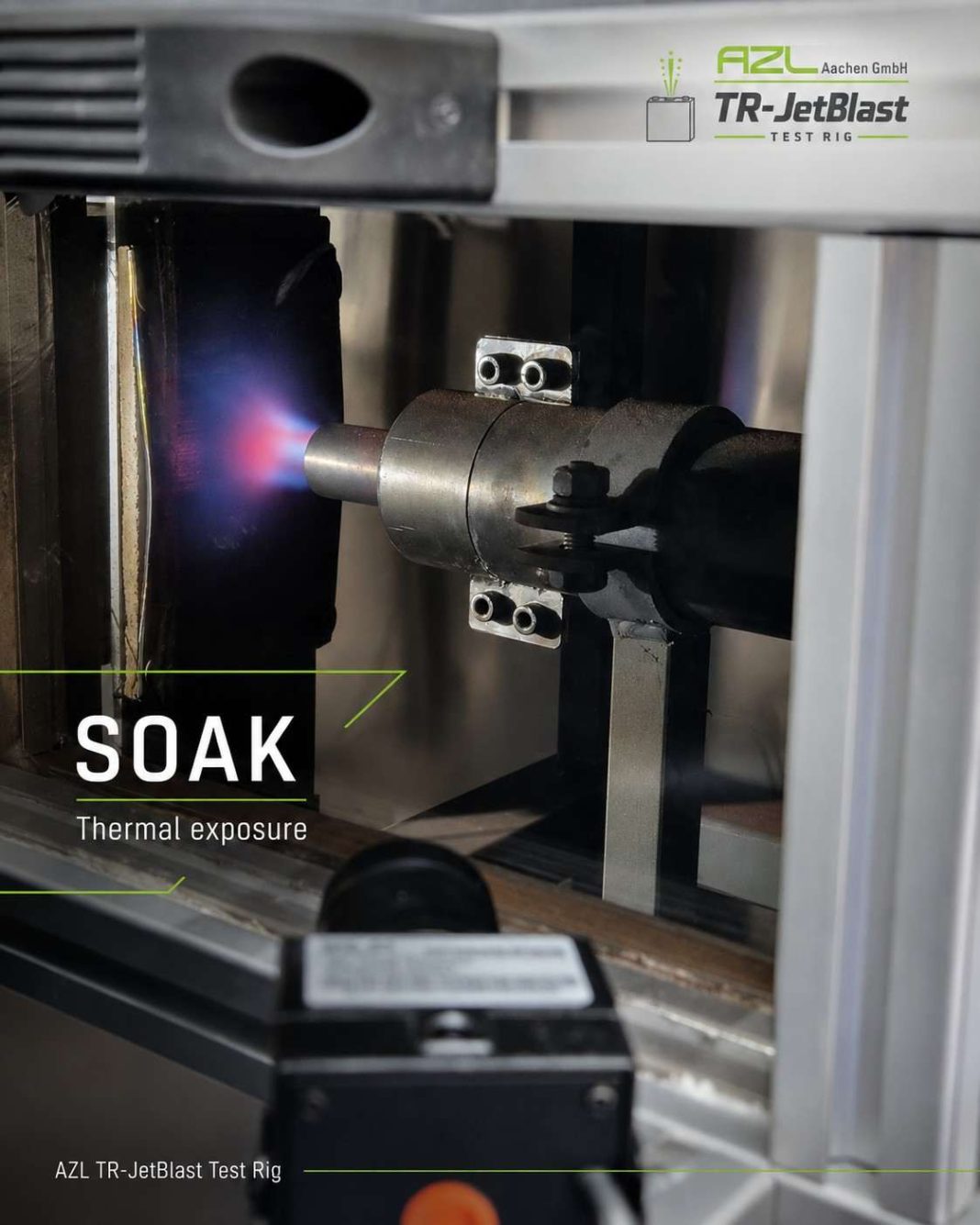
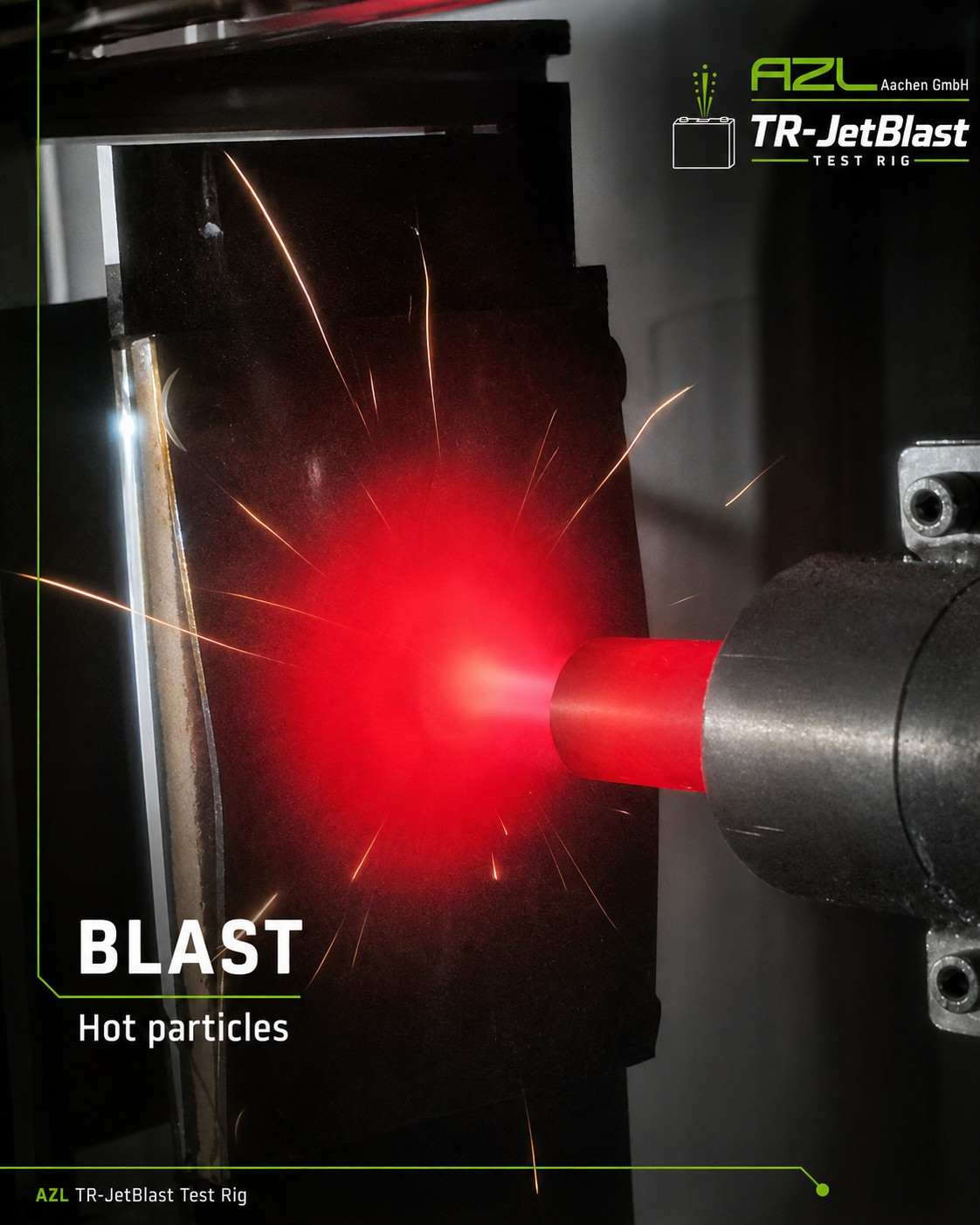
AZL Aachen GmbH has successfully commissioned its new JetBlast test system for the controlled simulation of selected application -relevant loads acting on battery-casing materials during cell venting and thermal-runaway events. The method combines high-temperature flame exposure with a heated, particle-laden blast and translates damage-driving thermal and erosive loads into defined laboratory profiles for material, stack -up and component development.
The system has been commissioned, and the initial calibration trials have confirmed the defined benchmark operating point for the ongoing AZL Joint Partner Project “Thermal Runaway Testing for Battery Casings”. AZL will complete the defined repeatability and reproducibility checks before participant materials enter the testing programme. The calibration protocol records control limits, measurement positions and uncertainty and provides the basis for validating each released JetBlast profile.
Interested companies can join the benchmark campaign .Testing of two participant-selected materials or material configurations per participant is included in the standard project offer.

Three test methods built from industrial development experience
JetBlast is the third method family in AZL’s application-relevant fire-testing development. The first evaluates material strength during fire exposure under a defined tensile load, representing the combined thermal and mechanical demand of pressure-derived membrane stress without generating pack overpressure. The second comprises custom torch-and-grit and high-intensity, high -mass-flow particle-blasting methods developed for OEM and Tier-supplier programmes.
Experience and partner feedback from these bilateral programmes and Joint Partner Projects led to JetBlast: an integrated method for coordinating flame temperature, particle temperature, particle mass flow, blast intensity and exposure time within one configurable sequence.The profiles can be informed by AZL real-cell and cell-array tests, industrial measurements, published data and simulation -based load predictions.
Rather than adapting a commercial torch, AZL developed a purpose -built burner and particle -injection architecture. At selected operating points, the system generates coupled thermal, particle and high-velocity gas-jet loads capable of producing damage patterns comparable to those observed under real cell-jet exposure. Engineering calculations indicate operation within a high -velocity compressible-flow regime. These calculations describe the gas flow—not directly measured particle velocity, which depends on particle size, loading and gas –particle interaction and remains part of the ongoing calibration.The objective is to reproduce the relevant loading mechanisms and order of magnitude of severe transient cell venting, rather than claim one-to-one equivalence with every cell format or thermal -runaway event.
Up to 1,650 °C near the specimen with a controlled blast differential
The JetBlast installation can establish test -zone temperatures of up to 1,650 °C, measured approximately 5 mm in front of the specimen surface. The current benchmark profile uses a defined base-and-boost sequence. In boost mode, the target at this near -surface measurement position is 1,300 °C before particle blasting begins.
Initial calibration trials measured the particle -laden blast at approximately 1,250 °C close to the same near-surface plane. The current operating point therefore produces a temperature differential of approximately 50 °C between the 1,300 °C boost target and the blast condition. AZL can adjust this differential through the operating settings; its stability and reproducibility will be documented in the released calibration protocol.
Heating the particle stream is central to the method. Cold carrier air can cool an already heated specimen and distort the intended combination of thermal and erosive loading. JetBlast reduces this blast -induced cooling and maintains a controlled transition between pre/post -exposure, jet flame loading, particle impact and any subsequent or repeated exposure phase.
“JetBlast is the result of several years of learning from mechanical-under-fire tests, high -intensity particle testing and direct feedback from OEM and supplier projects. The objective is not to imitate one cell event once. It is to identify the damage-driving loads, reproduce them in a controlled profile and use the evidence to match the material, protection concept and casing architecture.”
Ravi Chaitanya Bhairi, Head of Fire Testing | E -Mobility, AZL Aachen GmbH
Connecting loads, materials and casing design AZL positions JetBlast as part of an end-to-end battery-casing development process, not as a stand -alone laboratory test. The team combines load -case definition and fire testing with experience in casing structures, lid and tray concepts, cell formats and chemistries, cell -to-enclosure interfaces, venting paths, local protection and the practical trade -offs between safety, mass, cost and manufacturability.
This creates a material-architecture matching process: define the load for the selected cell format and chemistry; shortlist materials and stack-ups; screen them at coupon level; transfer the strongest concepts into the enclosure; and reserve component-or pack-level validation for the best variants. The supplier-independent method can compare metals, polymers, fibre-reinforced and sandwich structures, hybrid concepts, coatings, fire barriers, seals and insulation systems.
Evaluation is not limited to pass or fail. Outputs can include exposed – and backside -temperature development, time to threshold or burn-through, material integrity, damage area, mass loss, cracking or delamination, continued burning and failure modes. Relating results to thickness, areal mass, cost and integration constraints supports evidence-based decisions and reduces overdesign risk.
JetBlast is a screening and development method for selected thermal and particle -impact loads. It does not replace cell -, module -, pack – or vehicle -level testing under GB 38031-2025 or UN Regulation No. 100, and it does not generate pack overpressure. Pressure -driven structural effects can be addressed through AZL’s complementary tensile -under -fire method and must ultimately be verified at the appropriate integration level.
Experience from more than 150+ material tests and 85 partner companies
Across completed and ongoing battery-casing and fire-testing projects, AZL has tested more than 150 unique materials and worked with more than 85 unique companies, including six vehicle OEMs. The resulting knowledge base spans metallic, polymer-based, fibre-reinforced, coated, hybrid and multilayer protection concepts and connects material behaviour with enclosure requirements and observed failure modes.
Combined with real-cell observations, simulation -based load prediction and practical enclosure-design experience, these results allow AZL to support partners from early material selection through concept design and targeted validation. The role is effectively technical matchmaking: connecting the load case with the material system and the casing architecture most likely to meet it.
“Battery-casing development cannot be solved by selecting a fire-resistant material in isolation. Cell format, chemistry, venting, protection, structural load paths, mass and manufacturing all interact. Connecting design know-how with independent evidence helps partners focus on concepts that are technically robust and industrially realistic.
“Philipp Fröhlig, Managing Director, AZL Aachen GmbH
Joint Partner Project enters benchmark-testing phase
Participants in the ongoing Joint Partner Project gain access to the jointly generated benchmark results and to the know -how developed through the design, calibration and application of JetBlast. They can contribute requirements to relevant profiles and exchange directly with OEMs, battery -system developers, material suppliers and technology providers within the consortium.
Testing of two participant-selected materials or material configurations per participant is included in the standard project offer. Additional configurations can be integrated by agreement. Companies can join until September 2026. The next project meeting is scheduled for 23 September 2026, when the methodology will be presented in detail and demonstrated in operation.
Project information: https://azl-aachen-gmbh.de/en/projects/
#AZLAachenGmbH #modernplasticsnetwork #printmagazine #printpublication#modernplasticsglobal #modernplasticsisrael